September 21, 2026

7
min read
Data Loss Prevention Products Comparison: The Best of 2024
Data loss prevention products comparison for 2026: 11 DLP tools ranked on coverage, detection and remediation, and how Strac redacts data across SaaS and AI.
.webp)
Data loss prevention products comparison for 2026: 11 DLP tools ranked on coverage, detection and remediation, and how Strac redacts data across SaaS and AI.

· A data loss prevention products comparisonevaluates DLP tools on coverage, detection accuracy, remediation, deploymenteffort and cost, so you can pick the one that protects the channels your dataactually uses.
· The channels changed. In 2026 the fastestexfiltration path is a paste into a chat assistant, a file dropped into a Slackthread, or an agent reading a database over MCP, and most DLP products weredesigned for email gateways and network perimeters.
· Legacy suites are deep on one surface and thinon the rest; network-first platforms see traffic but not the content sittinginside SaaS apps; insider-risk tools watch behavior but rarely fix the data.
· Strac covers SaaS, cloud, browser, endpoint, AI DLP and MCP DLP on one data layer, andremediates by redacting sensitive data in place rather than only raising analert.
· Thiscomparison is part of the AIdata governance cluster. Start from that pillar if you are designing thewider program.
A data loss prevention products comparison is a structured evaluation of DLP tools against the channels, data types and remediation actions your organization needs.
Data loss prevention itself is the set of technologies that find sensitive data (PII, PHI, PCI data, credentials and intellectual property), watch how it moves, and enforce policy based on content and context. The four classic deployment types still exist: network DLP on egress traffic, endpoint DLP on devices, cloud DLP on SaaS and storage, and email DLP on mail flow.
What changed is that the categories no longer map to the risk. A single employee workflow now crosses all four: a customer export downloaded to a laptop, summarized in a browser AI tool, and pasted into a Slack channel. A comparison that scores products per category misses the handoffs, and the handoffs are where data leaks.
Three shifts reshaped the DLP market between 2024 and 2026.
Generative AI became the primary egress channel. Shadow AI tools appear on managed devices without procurement, and the data enters them through a paste or an upload in the browser. A network proxy sees an encrypted session to a chat domain; it does not see the patient record inside the prompt.
Agents started acting on data. An AI agent connected over MCP can query a CRM, read a ticket queue and return the result in seconds. Tool responses are a new data path, and almost no legacy product inspects them. This is why MCP DLP now sits on evaluation shortlists.
The vendor map consolidated. McAfee Enterprise DLP now ships as Trellix DLP. Digital Guardian and Clearswift sit inside Fortra. Code42 Incydr is part of Mimecast. Microsoft Information Protection is now Microsoft Purview. A shortlist written two years ago names products that have since been renamed, merged or repositioned.
The result is a simple test for any product on your list: can it see the content, on the surface where the data moves, and fix it without stopping the person doing the work.
Score every product on these seven criteria before you look at a feature matrix.
Coverage across real channels. SaaS apps (Slack, Google Drive, Gmail, Microsoft 365, Zendesk, Salesforce, Jira), cloud storage, managed endpoints, the browser, generative AI tools and MCP servers. Missing one surface means that surface becomes the exfiltration path.
Detection accuracy. Regex alone floods the queue with false positives and teaches people to ignore alerts. Look for trained detectors for PII, PHI, PCI and secrets, custom detectors for your own identifiers, and OCR that reads screenshots and scanned documents.
Remediation, not just alerting. The order matters, and it should be automatic:
Discovery and posture. Sensitive data discovery and classification at rest, plus DSPM to flag misconfigured sharing and overexposed storage.
Deployment effort. API-based SaaS connectors deploy in minutes; proxies, kernel agents and network appliances take quarters and a services budget.
Compliance mapping. Evidence that maps to SOC 2, ISO 27001, HIPAA, PCI DSS, GDPR and CCPA without a rebuild per audit.
Total cost of ownership. Licensing is the smaller number. Tuning time, analyst hours spent triaging false positives, and productivity lost to blanket blocking are the larger one.
The products below are the ones security teams most often shortlist this year. Each summary covers the core approach, the buyer it fits, and where it tends to stop short.
Strac is a DLP, data discovery and DSPM platform built API-first for SaaS, cloud, browser, endpoint, generative AI and MCP. It inspects content on every surface, including images and PDFs through OCR, and remediates automatically by redacting, masking, blocking, labeling or revoking access. SaaS connectors deploy in under ten minutes.
Best fit: cloud-first companies that need one control plane for SaaS, AI tools and endpoints, and want redaction instead of an alert queue.
Purview DLP is built into Microsoft 365 and extends to Windows endpoints, Edge and Copilot interactions. Sensitivity labels travel with documents across the Microsoft estate.
Best fit: organizations standardized on Microsoft 365. Coverage thins outside the Microsoft ecosystem, and policy tuning across E5 licensing tiers takes dedicated administrator time.
Symantec DLP is one of the most mature enterprise suites, with endpoint, network, email, storage and cloud modules and deep content fingerprinting.
Best fit: large regulated enterprises with an existing Broadcom relationship and a team to run on-premises infrastructure. Cloud and AI coverage depend on additional modules and integration work.
Forcepoint combines content inspection with risk-adaptive policy that tightens or relaxes enforcement based on user behavior, now alongside DSPM and data detection and response.
Best fit: enterprises that want behavior-weighted enforcement across endpoint, web and email. Deployment and tuning are typically services-heavy.
Fortra DLP runs a kernel-level endpoint agent with strong device and file-movement visibility, extended to network and cloud channels. Clearswift email DLP sits in the same portfolio.
Best fit: organizations protecting intellectual property on endpoints, including manufacturing and engineering environments. SaaS-native coverage is narrower than the endpoint story.
Proofpoint takes a people-centric approach that joins email DLP, cloud DLP, endpoint and insider threat telemetry, with DSPM added through its Normalyze acquisition.
Best fit: organizations whose primary risk channel is email and whose security team already runs Proofpoint. Remediation inside collaboration apps is more limited than in mail flow.
Netskope delivers DLP inside a security service edge platform, inspecting SaaS, web and cloud traffic inline and through API connectors, including prompts sent to generative AI apps.
Best fit: teams consolidating on SSE and routing traffic through a cloud proxy. Value depends on traffic actually flowing through the proxy, and in-place redaction inside SaaS is not the default action.
Zscaler embeds DLP into its Zero Trust Exchange, inspecting inline traffic with CASB controls and shadow AI discovery.
Best fit: organizations already on Zscaler Internet Access. Like other network-first products, it sees data in transit through the proxy more readily than data already sitting in a SaaS app.
Incydr is an insider risk product that tracks file movement to USB, personal cloud, email and browser uploads, including pastes into generative AI tools.
Best fit: teams focused on departing-employee risk and file exfiltration investigations. It is built to surface risky behavior rather than to redact content in place.
Cyberhaven traces data lineage, following where a piece of content originated and every place it moved, and uses that history to classify and enforce policy.
Best fit: organizations that want lineage-based context for insider risk and AI data flows. Most enforcement runs through its endpoint and browser agents.
Trellix DLP offers endpoint, network and discovery modules with device control, rooted in the McAfee Enterprise codebase.
Best fit: existing McAfee customers maintaining an on-premises estate. Cloud and generative AI coverage is less central to the product than endpoint control.
Read the eleven summaries together and a pattern appears. Suites are deep on the surface they started on; proxies see traffic, not content at rest; insider-risk tools explain what happened after it happened.
The common gaps show up in the same places:
An alert tells you data leaked. Redaction means it did not.
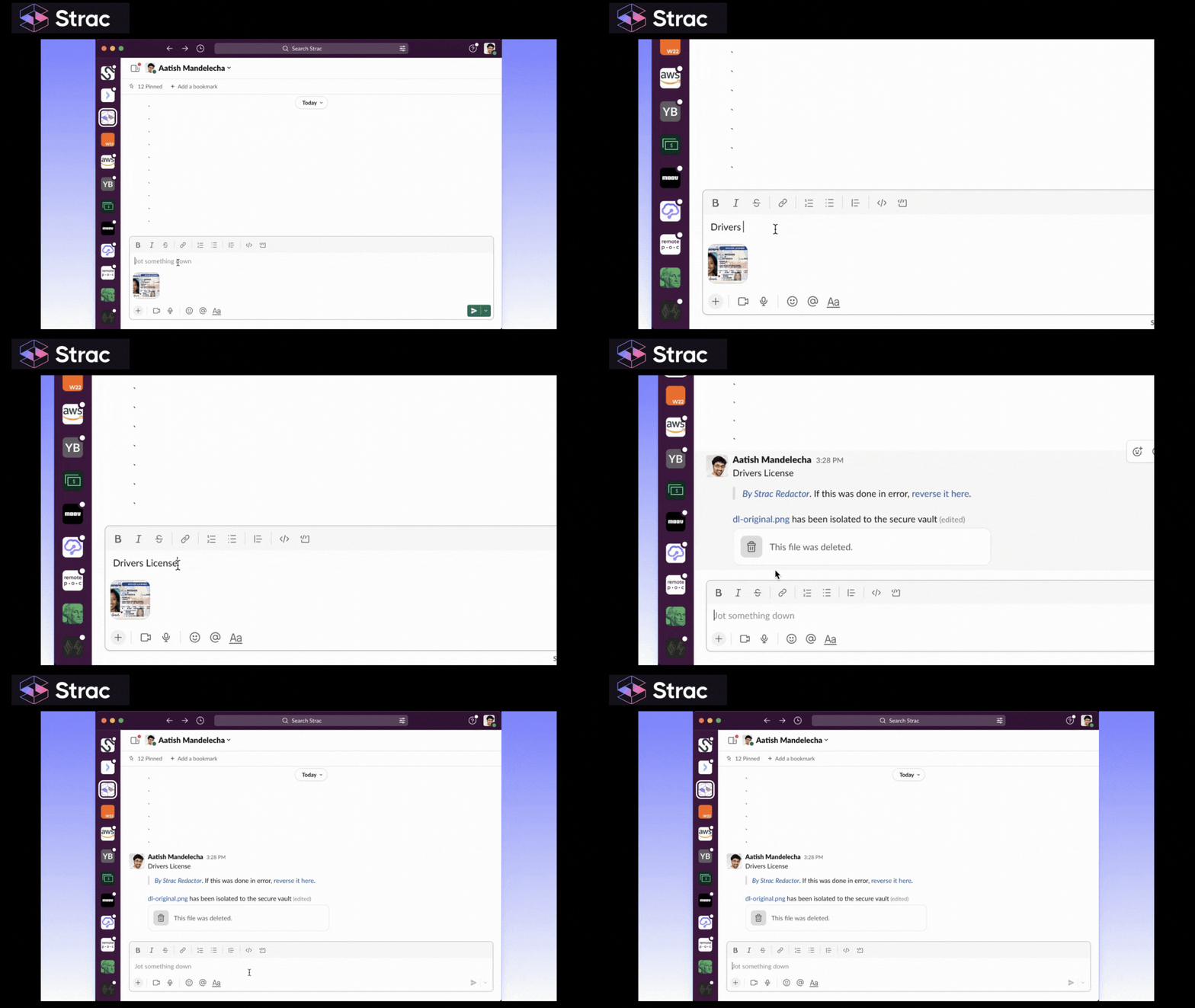
Watch Strac detect a customer record in a Slack message, redact it in place, catch the same record pasted into a ChatGPT prompt, and strip it from an MCP tool response before the agent sees it.
One policy, three surfaces: Strac removes the sensitive element and leaves the work intact, which is what makes enforcement survivable for the people doing the work.
Strac inspects content wherever sensitive data moves and remediates it automatically, from one console and one policy set.
SaaS. SaaS DLP connects by API to Slack, Google Drive, Gmail, Microsoft 365, OneDrive, Zendesk, Salesforce, Jira, Notion, Intercom, HubSpot, Box and more. Slack DLP, Google Drive DLP, Gmail DLP, Office 365 DLP and Zendesk DLP redact in place, revoke public and external sharing, and apply labels. The full list lives on the integrations page.
Endpoint and browser. Endpoint DLP covers managed devices including macOS and Linux DLP, and Browser DLP in Chrome and Edge inspects pastes, uploads and form submissions at the moment of the action. Strac keeps no keystroke logs or screenshots.
Generative AI and shadow AI. AI DLP and ChatGPT DLP redact sensitive data before it reaches ChatGPT, Claude, Gemini or Copilot, while shadow AI discovery shows which tools are in use and which data classes are heading to them. See how to detect shadow AI for the detection side.
MCP and agents. MCP DLP inspects every agent tool call and response, redacts PII, PHI and secrets, and flags prompt injection attempts across the MCP integrations. It is the control that lets you protect AI agents without removing their tools.
Discovery, DSPM and lineage. Strac scans SaaS, AWS S3, Azure and Google Cloud at rest, flags overexposed data through DSPM, and tracks file origin through persistent fingerprinting. The PII scanner reads documents and images, not only text fields.
Compliance. Controls map to HIPAA, SOC 2, ISO 27001, PCI DSS, GDPR and CCPA, and Strac Comply turns the same remediation events into continuous audit evidence. Teams with custom pipelines use the API docs to redact data inside their own applications.
Other products tell you where sensitive data went; Strac changes what arrives there.
A longer operational version lives in the DLP security checklist.
Related reading:
Every product on this list protects something; the question is whether it protects the channels your data uses today. Identity, network and endpoint controls all fail eventually, and the data layer is the backstop: redact sensitive data on every action across SaaS, cloud, browser, endpoint, generative AI and MCP, and a compromise never becomes a breach. Book a demo to see Strac run that data layer in your own environment.
No. A CASB or SSE platform controls access and inspects traffic that passes through its proxy. A DLP product inspects the content itself, at rest and in motion, and remediates it. Many SSE vendors include DLP, but content that never crosses the proxy stays unseen.
Because it was designed for email, network and file channels. Prompts travel inside encrypted browser sessions and MCP responses travel between an agent and a tool, neither of which a gateway or kernel agent was built to read. See why legacy DLP fails for AI.
No. Blocking pushes people to personal devices and removes visibility. Redaction and vaulting let employees keep using generative AI while the sensitive element never leaves, which is safer for the data and easier on productivity.
No. Every detector has a false negative rate, and people find new channels. That is why the data layer matters: when remediation defaults to redaction on every action, whatever escapes a missed control is already stripped of its sensitive parts.
The one that connects to your SaaS apps by API, covers the browser and AI tools, and redacts automatically. For cloud-first teams that usually rules out appliance-based suites. Start from the AI data governance pillar to scope the program.
.avif)


.gif)